It’s funny how these things start. You don’t wake up one morning planning to turn your living room into a low-grade gym. You usually wake up because your kids are using your new sofa as a launching pad for a wrestling match, and you realize something has to change, or you are going to lose your mind. That’s how the indoor monkey bar idea started for me. Pure, desperate parental necessity.
I was catching my 8-year-old, Maya, trying to scale the pantry door, and my 6-year-old, Liam, was using the dining room chair as a barbell. They were bored and the weather outside had been garbage for weeks. My solution before? More screen time. I cringed just thinking about it, knowing I was trading my sanity for their weak little thumbs getting stronger.
The Decision and the Hardware Nightmare
I knew they needed to burn energy, real energy, not just bouncy castle energy. I looked at the local rock-climbing gyms. Too expensive. I considered a full home gym setup. Way too much space. Then I stumbled across the indoor kits—the ones that promise to fit “easily” into a standard doorway or ceiling space. I read a million reviews, mostly by people who clearly had never held a drill, much less used one. I finally pulled the trigger on a heavy-duty steel frame model, the kind that anchors straight into the ceiling joists. It was pricey, but the thought of my kids crashing through the drywall was more expensive.
The delivery showed up in three massive, dented boxes. Heavy is an understatement. I dragged them into the garage and ripped the cardboard open. Immediately, I saw the problem: a huge pile of parts and instructions that looked like they were translated from Mandarin to German, and then straight into a weird, broken English dialect. I spent 45 minutes just sorting the bolts and rods, trying to figure out which piece was which. I laid everything out on a tarp.
I found my stud finder. It’s a cheap one, maybe $20. It lied to me. Over and over. I tapped the ceiling, listened, and marked what I thought were the center lines of the joists. I got the ladder, crawled up, and drilled the first pilot hole for the massive lag bolt. Nothing. Just plaster dust. I cursed under my breath, patched the hole with spackle, and moved six inches over. Again, a miss.
I kicked the box of hardware and drove straight to the hardware store for a pro-grade magnetic stud finder. Expensive, but it did the job. I went back and methodically marked every joist. This wasted two hours, but it saved me about ten more holes in the ceiling.
The installation itself was a bear. I had to hold the heavy steel frame with one arm while driving the massive lag bolts through the pre-drilled holes with the other. My arms gave out three times. I roped my oldest son, Liam, into holding the ladder steady while I muscled the drill into the ceiling. After three hours of pure, heavy labor, sweating like I ran a marathon, the main frame was finally solid. It didn’t wobble. I yanked on it. It didn’t move. Relief washed over me.
The Unexpected Reality and the Payoff
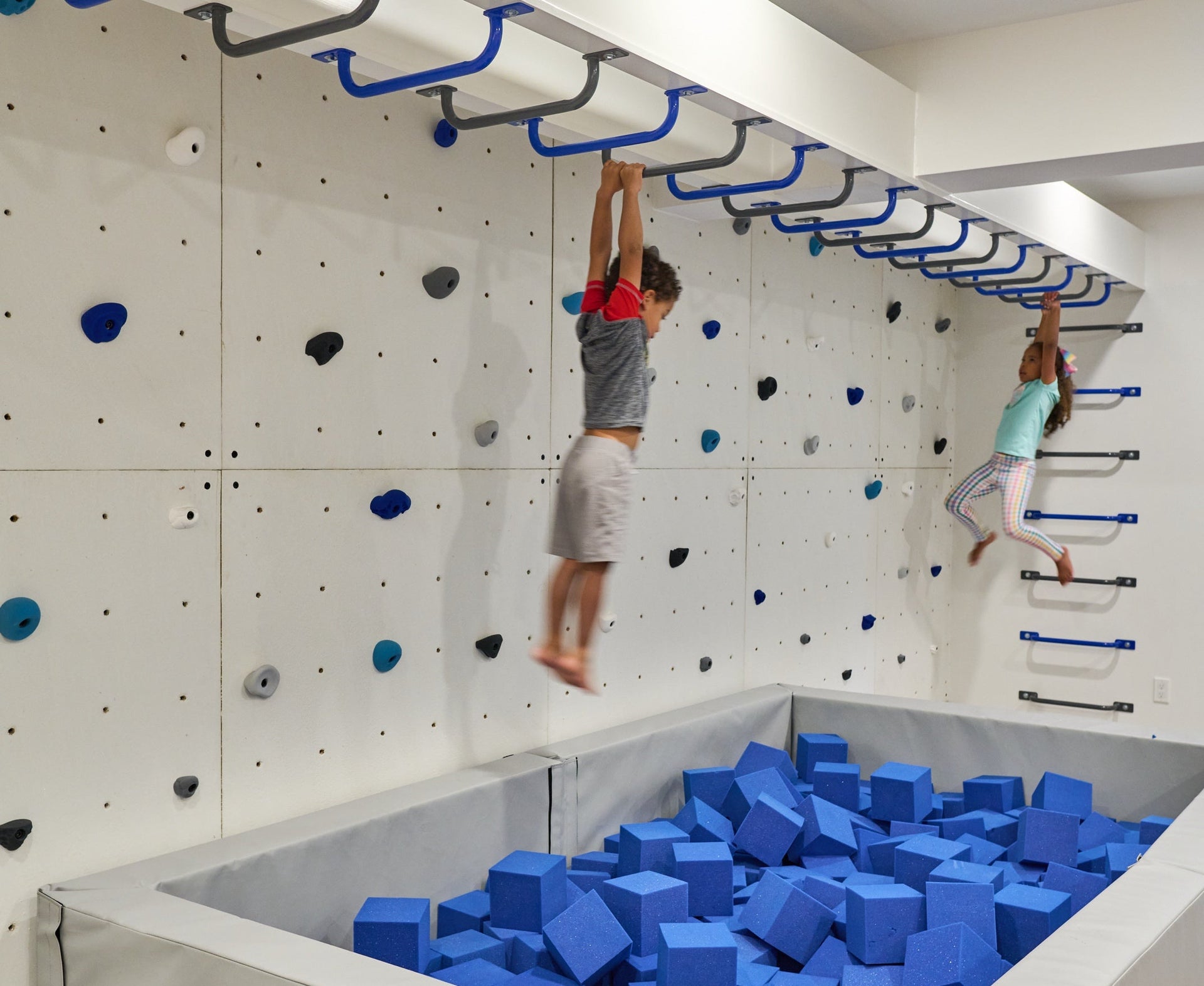
The kids didn’t wait for me to finish the last stabilizer bars. They were already climbing up the frame. I stood back and watched them. They were cautious at first. They just hung, their little fingers clenching the cold metal bars. They didn’t have the grip strength I expected them to have. They dropped off after just ten seconds. This is where I realized the core problem with the modern kid: they have plenty of leg strength from running around, but zero upper body and grip strength. It all comes from screens and structured activities.
This whole project, the decision to go this messy route, came to a head a few months before I installed the bars. I got a call from the gym teacher at Maya’s school. She told me that Maya failed the basic Presidential Fitness Challenge element: the flexed-arm hang. She couldn’t hold her own weight for more than four seconds. I was slightly embarrassed, then I remembered my own childhood, where we spent 80% of our day swinging from something. We were tough. My kids were soft. That call, that little piece of information, lit a fire under me. That’s why I ignored the screen time easy button and wrestled with 100 pounds of steel for half a day.
The fitness benefits came fast. I saw the change in weeks:
- Grip Strength Exploded: They started holding on longer. Pretty soon, they didn’t drop off at all. They could hang for a solid minute, then two. That strength transferred to everything: climbing trees outside, carrying heavy backpacks, even opening tough jars.
- Better Focus: The biggest, most immediate benefit. When they got home from school, they attacked the bars. They dumped all their restless energy into swinging and flipping. By the time they got to homework, the fidgeting was gone. The quiet was beautiful.
- Core/Shoulder Stability: I noticed Liam’s posture straightening out. He used to slouch over his tablet. Now, when he walks around, his back is straight. All that swinging worked their deep core and shoulder muscles without them even realizing it.
It’s not a decoration. It’s an eyesore if I’m being honest, a big steel cage in the living room. But it’s the most used piece of furniture in the house. I started this whole mess because I needed to stop the bouncing off the walls, but I ended up fixing a fundamental strength problem I didn’t even know they had. That’s the real win. You want an easy button? This wasn’t it. But the results are undeniable.